Beyond the Ice: How Michigan is rewriting the rules of outdoor access
Over the past decade, the Michigan Ice Fest has become a proving ground for a broader shift unfolding across the state’s outdoor recreation landscape.
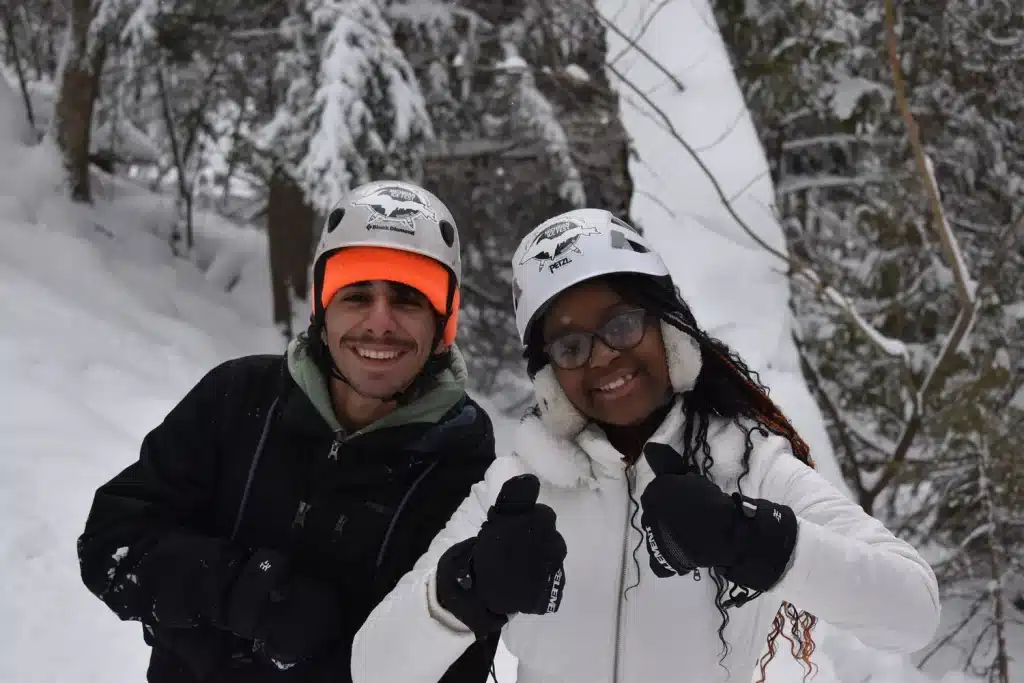
In mid-February, Munising becomes a convergence point. Climbers from across the United States and abroad arrive in the Upper Peninsula for frozen waterfalls and technical instruction.
Drawn by the rare ice formations along Lake Superior and the sandstone cliffs of Pictured Rocks National Lakeshore, they gather for the annual Michigan Ice Fest, one of the largest ice climbing festivals in North America.
Yet the most consequential changes taking place at the festival are not etched into the ice. Over the past decade, the Michigan Ice Fest has become a proving ground for a broader shift unfolding across the state’s outdoor recreation landscape: a move away from passive access toward intentionally designed inclusion in outdoor sports.
That shift, driven by partnerships among state agencies, private industry, and community organizations, offers a glimpse of how Michigan is rethinking who outdoor recreation is for, how people get there and what meaningful access actually looks like.
From tradition to intentional design
Ice climbing is not an activity people stumble into. It requires specialized equipment, technical knowledge, and proximity to very specific terrain. Those barriers are compounded by cultural norms that have historically shaped who feels welcome in the sport and who does not.
Bill Thompson, organizer of Michigan Ice Fest and co-owner of Down Wind Sports, said the festival began confronting those dynamics in the early 2010s. At the time, participation skewed heavily male, reflecting broader trends in climbing culture.
“Traditionally, our sport has been all male,” Thompson said. “So the first foray into our diversity program was adding a lot of women’s programs. And that was very successful.”
What followed surprised organizers. Women reported feeling more comfortable learning from female instructors, and the presence of women in leadership and instructional roles changed not only participation numbers, but the culture of the festival itself.
“We really saw that women learn better from other women,” Thompson said. “Once we started building that instructor base, everything changed.”
Today, Thompson estimates women make up roughly half of Ice Fest participants. That success prompted organizers to ask a more expansive question: If intentional program design could address gender imbalance, could it also confront other forms of exclusion embedded in the sport?
The Diversity Track as structure, not symbolism
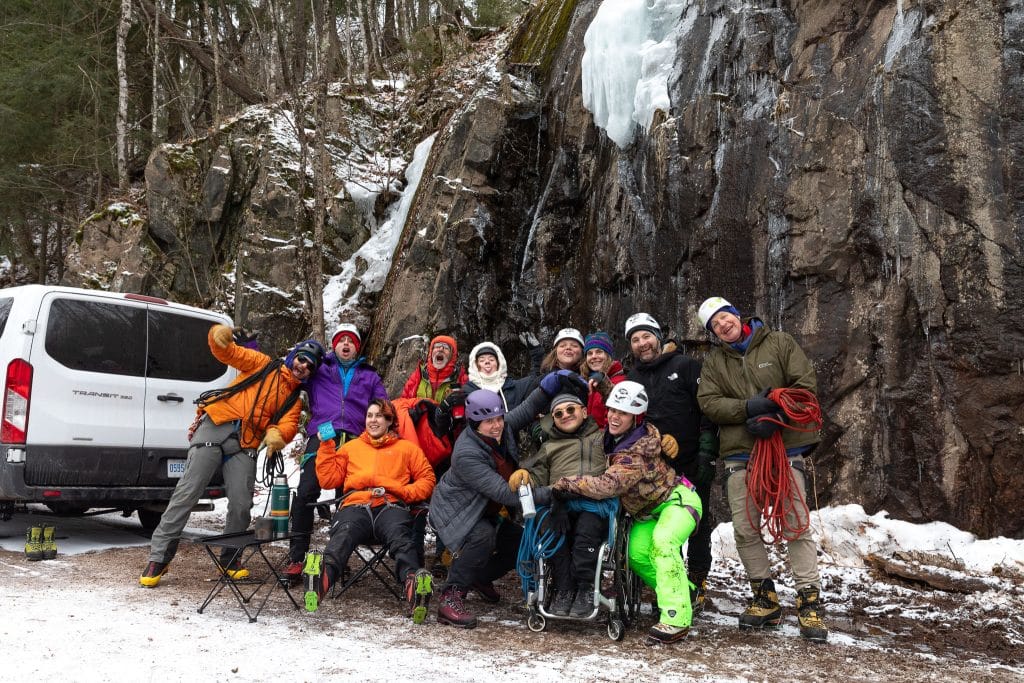
That question led to the development of Michigan Ice Fest’s Diversity Track, created in partnership with Black Diamond Equipment and Michigan’s Office of Outdoor Recreation Industry. The Diversity Track encompasses multiple pathways, including women-focused instruction, introductory clinics for climbers of color, and adaptive climbing opportunities for people with physical disabilities.
Rather than functioning as an add-on, the Diversity Track mirrors the festival’s core instructional model. Participants receive professional-level instruction, access to specialized gear, and mentorship in environments structured to reduce intimidation and uncertainty.
For climbers of color, that can mean learning alongside other Black, Indigenous, and People of Color climbers and being taught by instructors who share similar identities. For adaptive climbers, it involves advance coordination, specialty equipment, and site selection that accounts for mobility and safety needs.
“Ice climbing is not an activity where anyone can walk into a store, buy the gear, and go out and climb,” Thompson said. “So what Ice Fest really is, is an opportunity. We provide the gear, the instruction, and the access.”
That access is not improvised. Thompson said festival organizers follow up with adaptive climbers well in advance to understand individual needs and determine what accommodations or site adjustments are required. The goal, he emphasized, is not to lower standards, but to remove unnecessary barriers.
“When you have people climbing with instructors who look like them and understand where they’re coming from, it changes everything,” he said. “They go, ‘Yeah, we can do this.’”
An industry reckoning with access
For Black Diamond Equipment, a longtime sponsor of Michigan Ice Fest, the Diversity Track reflects a broader reckoning within the outdoor industry about who its sports actually serve.
Jess Powell, advocacy and sustainability manager for the company, said the partnership was rooted in alignment rather than outreach.
“We partnered with MIF on its Diversity Track because there was alignment with our broader advocacy goals,” Powell said. “We have worked diligently as a brand to make the sports we serve more accessible to marginalized communities and those facing larger barriers. And supporting initiatives like these was a natural and simple alignment.”
Over time, Black Diamond’s support has included financial funding for scholarships, product support, and the integration of access-focused partners such as adaptive climbing organizations. Powell said those contributions matter because ice climbing presents one of the most complex access challenges in outdoor recreation.
“Almost every aspect of ice climbing is a barrier,” she said. “The product is expensive, it is located in remote areas, there aren’t that many places nationwide where ice climbing can even happen, and there is a tremendous amount of skill and knowledge that is necessary to ice climb safely. By doing the right thing, contributing where we can, and lowering barriers when we are able, we are doing our part to help make the sports we serve more accessible to everyone.”
“The best way to help folks feel welcome is to give them a community,” she said, adding that being explicit about industry support helps challenge assumptions about who outdoor spaces are meant for.
Trust before the climb
For Detroit Outdoors, inclusion begins long before participants arrive in Munising. Garrett Dempsey, lead Sierra Club staff member for Detroit Outdoors, described the organization’s work as fundamentally rooted in trust and relationship-building.
“When we think about inclusive outdoor recreation, we really think about a sense of community,” Dempsey said.
Detroit Outdoors works closely with classroom teachers, youth agency staff, and other trusted adults so that invitations to outdoor experiences come from people families already know. That trust, he explained, is essential for overcoming the financial, cultural, and experiential barriers that often keep young people from outdoor spaces.
“Experience and comfort level in the outdoors can be a barrier,” Dempsey said. “So we build a ladder of experience — close to home first — before asking young people to imagine something like ice climbing in the Upper Peninsula.”
When those young people do make the journey north, the impact is immediate. Dempsey described crossing the Mackinac Bridge as a moment of visible excitement, phones raised to capture a place many participants have never seen before. Once in Munising, the experience expands beyond the climb itself.
Even for participants who do not continue climbing, Dempsey said, the experience leaves a mark. They gain confidence, a sense of shared accomplishment, and exposure to landscapes that reshape how they see themselves in relation to the outdoors.
In some cases, those early experiences ripple outward into leadership roles, mentorship, or new opportunities formed through relationships seeded at Ice Fest.
“You can’t necessarily script it from the beginning,” Dempsey said. “But you’re doing the relationship building and community building in the moment because it’s the right thing to do.”
State infrastructure catching up to intention
While Michigan Ice Fest and Detroit Outdoors focus on program-based inclusion, the Michigan Department of Natural Resources has been working to build the infrastructure that makes outdoor access possible year-round. Those efforts are coordinated through an internal Accessibility Team and guided by an Accessibility Advisory Council composed of private citizens.
Michelle O’Kelly, a philanthropy specialist with the DNR’s Parks and Recreation Division and chair of the department’s accessibility team, said accessibility work has evolved significantly over time.
“The accessibility team has been around for over 10 years,” she said, explaining that it was designed to provide cross-divisional guidance on programs, construction, policy, and legislation.
In 2007, that internal work was complemented by the creation of the Accessibility Advisory Council, which brings external perspectives and lived experience into the planning process.
“For a long time, accessibility was treated as a checkbox,” O’Kelly said. “Now we’re trying to think about it more holistically — about how people actually experience these places, not just whether they technically meet a standard. Accessibility isn’t one thing,” she continued, “It’s many things, and it changes depending on the person.”
That shift has translated into tangible infrastructure. Michigan now offers dozens of all-terrain track chairs at state parks, accessible trails and beaches, adaptive permits for hunting and ORV use, sensory-friendly programming, and digital tools that allow visitors to assess accessibility features before arriving. Much of that work, O’Kelly noted, depends on designated funding streams and philanthropic partnerships rather than general operating budgets.
In the Upper Peninsula, geography adds complexity. O’Kelly acknowledged that population density often drives where resources are concentrated, even as destinations like Pictured Rocks draw some of the state’s highest visitation numbers. Events like Michigan Ice Fest, she said, help make demand visible.
“When people can see inclusive programs working, it changes the conversation,” O’Kelly said. “It moves accessibility from an abstract idea to something concrete.”
Why intentional inclusion matters now
Taken together, these efforts reflect a shared understanding that access to outdoor recreation is not self-correcting. Without intentional design—whether through festivals, public lands, or partnerships—high-barrier sports tend to replicate the same exclusions decade after decade.
For Thompson, inclusion is not a peripheral concern but a prerequisite for the sport’s future. “If we want this activity to be viable long term, we have to be more inclusive,” he said. “It makes for a better, stronger community.”
In Munising, that work unfolds against frozen waterfalls and Lake Superior winds. But its implications extend well beyond a single festival. As Michigan continues to rethink how outdoor recreation is planned, funded, and experienced, Michigan Ice Fest offers a case study in what inclusion looks like when it moves from aspiration to structure.