Building a Legacy: New endowment fund helps secure the future of the Iron Ore Heritage Trail
Marquette residents Bill and Dea Danly worked with the Community Foundation of Marquette County to establish the fund.
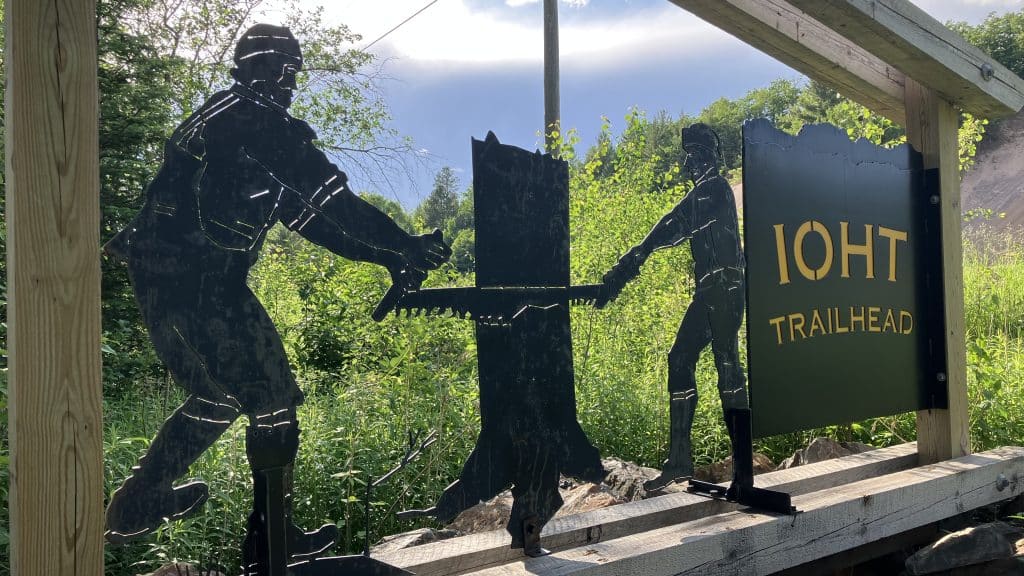
In another show of financial support for Marquette County’s recreational trail systems, new donors have stepped up to establish an endowment fund aimed at sustaining the 47-mile Iron Ore Heritage Trail (IOHT) into the future.
The trail network is known for its natural beauty, its multiple recreational offerings and its historical sites, artwork, artifacts and signage promoting the geological and historical significance of the Marquette Iron Range.
Marquette residents Bill and Dea Danly worked with the Community Foundation of Marquette County to establish the fund, which is not yet designated for a specific project or improvement. The donation amount isn’t being publicized.
“Building an endowment takes time, and it will be several years before investment returns are substantial enough to meaningfully impact the annual budget,” explains Bob Hendrickson, trail administrator for the Negaunee-based Ore Heritage Trail Recreation Authority, which manages the network.
“The Danlys intend to continue contributing to the fund over a number of years, with the goal of also encouraging additional community members to support and grow the endowment. Their initial gift represents the beginning of something much larger with lasting, long-term impact.”
Bill Danly calls the couple’s contribution “seed money.”
“We use the IOHT a lot,” he notes. “We’re hoping the IOHT fund grows over time from additional donations and good investment decisions by the foundation.”
Hendrickson says the annual budget for sustaining and improving the network for warm-weather usage is now about $300,000, with other entities paying for trail grooming for winter sports from December through March.
News of the IOHT monies comes just a few months after the announcement of a similar endowment funded by Dr. Cary Gottlieb and Dr. Carol Gamber targeted toward maintaining the 150-mile Noquemanon Trail Network (NTN) in Marquette County. Those monies are also being administered by the foundation.
“It seems like in our community, a lot of people are stepping up and creating long-term solutions to keep our legacy areas available to the public,” Hendrickson notes. “And the IOHT has really been well-embraced by the community. People are really attached to it.”
Growth of a strong community asset
Conceived circa 2006, the mostly state-owned trail system secured sustainable funding between 2008 and 2010 when seven of the 10 municipalities it traverses approved millages aimed at its upkeep. Today, all 10 municipalities (the cities of Ishpeming, Marquette and Negaunee and the townships of Republic, Ely, Tilden, Negaunee, Marquette and Humboldt) contribute such millage funding.
Constructed mostly of paved, limestone and crushed granite surfaces, the route repurposes mostly unused railroad corridors that once carried lumber north to Lake Superior Harbor when it dominated U.S. iron ore production circa 1880 to 1900.
Not only can visitors view sites of historical interest like 18th and 19th century mining pits, mining shafts, head frames, forges, and furnaces, but they can access several downtowns and visit attractions such as the Michigan Iron Industry Museum in Negaunee and the Cliff Shafts Mine Museum in Ishpeming. The network also serves as a resource for educators teaching about archaeology, geology, history and/or business.
With its mix of motorized and non-motorized trails, the 10-trailhead system also caters to a wide variety of outdoor enthusiasts including runners, walkers, hikers, cross-country skiers, birdwatchers, photographers and recreational vehicle drivers.
Designated a National Recreation Trail in 2018, it hosts several annual events, including the Marquette Marathon for runners, which draws about 1,000 participants annually; the Iron Range Roll race for cyclists; and the Marji Gesick race for mountain bikers. Natural highlights include the Lake Superior shoreline, multiple creeks and rivers and a newly constructed 700-foot boardwalk that takes pedestrians through a local marshland.
Parts of Marquette County land inhabited by the trails also represent the ancestral and present-day homelands of the Anishinaabe Three Fires Confederacy of Ojibway, Odawa and Potawatomi nations.
Outdoor enthusiasts bring their wallets
Research shows maintaining trails in Marquette County is more than just a public service: it’s also a financial boon. A study by Public Sector Consultants released in 2024 found that users of those trails make a significant impact on local economies, contributing $22.1 million to the annual gross regional product and $27 million in the annual economic output. Event and nonevent spending generated by those users directly supports 308 jobs, with another 87 jobs and $14.3 million generated via their more indirect purchases.
Visitors from outside the Upper Peninsula are responsible for 61 percent of that economic output, it reports, while U.P. residents account for 39 percent.
Further, county trail usage has risen 20 percent since pre-pandemic times, according to the Lake Superior Community Partnership website.
Looking ahead to more trail expansion
In the five-year plan for the IOHT, Hendrickson says, is a 4.5-mile eastward extension of the trail in Chocolay Township that will provide a direct rail connection to Lakenenland Sculpture Park, a 37-acre collection of metal sculptures created by artist Tom Lakenen.
In addition, the authority is working with the NTN collaborative on a project called Koski Woods which involves building out additional non-motorized trails utilizing a stacked loop system. The loops will be developed on about 176 acres of Marquette and Negaunee Township land partially gifted to the trail system last year by the Schwemen and Britton families.
Additional future needs include upgrades to several trail surfaces to improve durability, as well as improvements to multiple bridges and culvert systems to better address recurring spring flooding issues, he says.
“Trails are an essential part of Marquette’s identity and play a crucial role in the area’s economy, quality of life and tourism industry,” reports the partnership site. “Communities throughout the region seek opportunities for connections that will bring added trail users and visitors to their communities and businesses. These pressures require a shared vision from multiple stakeholders to ensure trails and green spaces are sustainable”.
Related Articles
Brrrr: The Heikinpäivä Polar Plunge returns to Hancock in February
The return of the polar plunge, organizers said, elevates Heikinpäivä’s role as the official kickoff to Hancock’s winter festival season.
The eastern U.P.’s Hiawatha Heritage Dog Sled Race returns
Changes this year include the addition of an eight-dog, 80-mile overnight endurance race in two segments.

LSSU celebrates golden anniversary of famous Banished Words List
The annual list began as a whimsical New Year’s eve party idea in 1976.