
Partner Partner Content Enbridge’s St. Ignace center offers details about the Great Lakes Tunnel
The Great Lakes Tunnel Information Center provides the community with information about Enbridge’s plan to build a tunnel under the Straits of Mackinac.
Not too long ago, a pair of women opened the entrance door to the Great Lakes Tunnel Information Center in St. Ignace, peered inside and then gave Rene Halberg and other staff on hand an enthusiastic thumbs-up.
That slight, though positive interaction – support for the proposed Great Lakes Tunnel – is not uncommon at the information center, which opened in 2021 and was given a refresh in May. More typical, however, are visitors and passersby stepping inside to explore various displays and ask questions.
“People are really interested in the tunnel project. We get a lot of questions – people are curious how it’s going to be built, what kind of machinery will be used, how long it will take,” says Halberg, an Enbridge community ambassador.
The Great Lakes Tunnel Information Center provides the community and visitors alike with a wealth of information about Enbridge’s plan to build a state-of-the-art tunnel under the Straits of Mackinac to replace an underwater stretch of Line 5, an existing pipeline transporting light crude oil and natural gas liquids.
The megamillion-dollar project would encase a replacement pipeline in a concrete tunnel, deep beneath the lakebed, further protecting that section of Line 5 from any potential ship-related or other accidents. An anchor strike is the biggest risk facing the current pipeline, anchored to the bottom of the Straits.
For more than 65 years, Line 5 has transported light crude oil and natural gas liquids from Wisconsin to Sarnia, Ontario, Canada, where they are refined into propane. Enbridge transports about 30 percent of the crude oil produced in North America and moves about 20 percent of all natural gas consumed in the United States.
The tunnel project, of course, has raised a lot of questions.
“The purpose of the building is for people to come in who have questions, concerns, or want to meet an Enbridge representative,” says Paul Meneghini, who is Enbridge’s manager of community engagement in Michigan. “Hopefully, we can answer their questions here on site and they can learn a little about us, what we do, and about the project.”
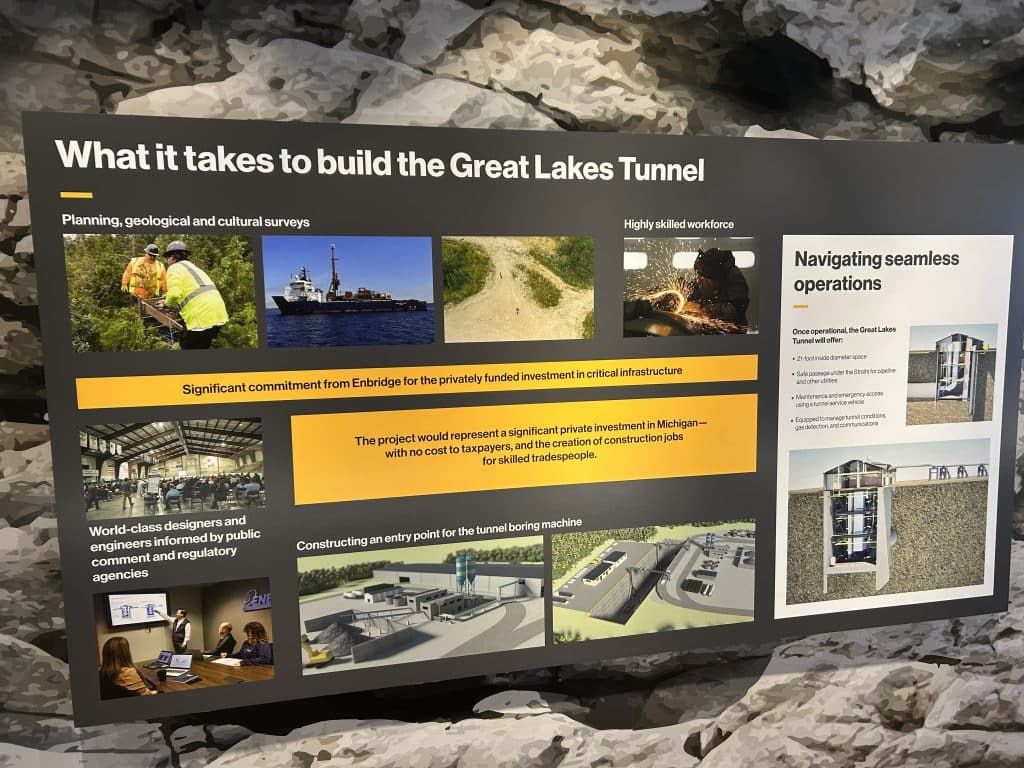
Visitors can learn about the tunnel’s construction, safety measures and engineering through a variety of displays and images. Other exhibits share information about the geology of the Straits and the role of energy infrastructure.
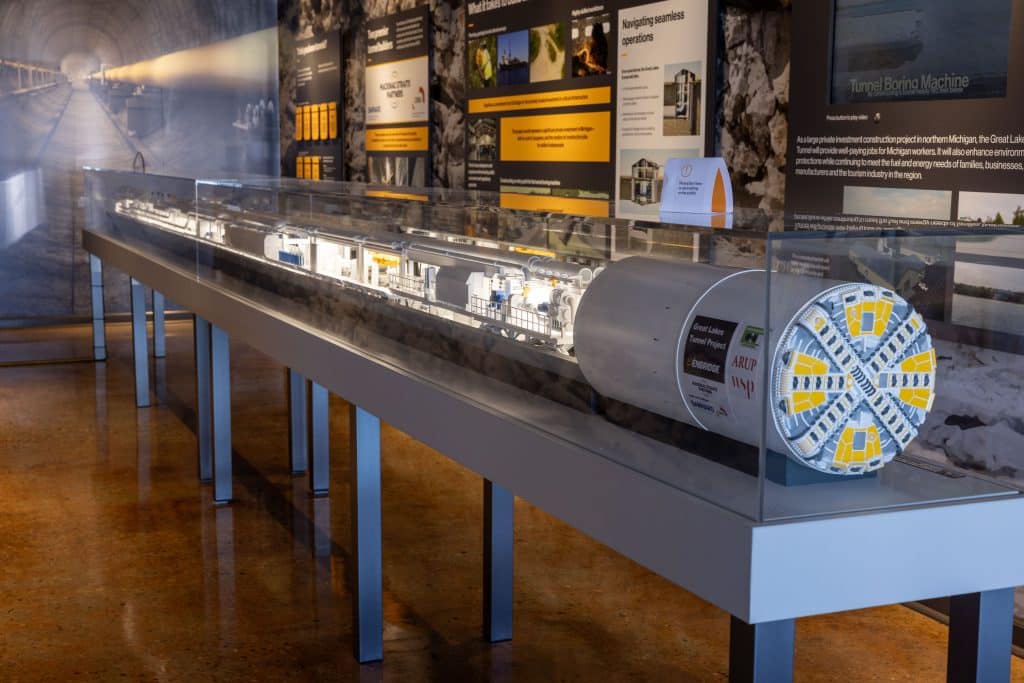
A highlight for many is a working scale-size model of the tunnel boring machine that will be used to create the tunnel. The German-built, high-tech machinery will bore through rock anywhere from 60 to 250 feet below the lakebed.
“Seeing the model of that machine is awe-inspiring to many,” Halbert says.
The 22-foot-long model is housed in the back of the building, in a space that replicates an underground tunnel. The model includes cutterheads that slowly rotate, giving visitors an idea of how the tunnel will be excavated.
“It’s the Cadillac of machines,” Meneghini says, noting that the machine is being built in Germany and will be transported to America by boat. The company is a leading manufacturer of tunnel boring machines, involved in major tunnel projects around the globe, including in France, India and China. “The technology they’re using to build tunnels is amazing.”
The real tunnel boring machine, custom-built for the Great Lakes Tunnel, has its work cut out for it. The machine will have to cut a 3.8-miles-long tunnel to house the new pipeline, beginning about one and one-half miles west of the Mackinac Bridge, near where the current pipeline submerges into the Straits.
Six hundred feet long, with an internal diameter of 21, the machine was designed to handle the specific geological conditions of the lakebed of the Straits, composed of bedrock through three formations: Bois Blanc,which is a cherty limestone or dolomite; St. Ignace, which is dolomite and shale; and the Point Aux Chenes, which is shale with dolomite.
While boring deep under the lakebed, the tunnel boring machine will remove sand, gravel and three types of bedrock, by means of a conveyor belt, while also creating a thick-walled concrete tunnel to house the pipeline.
“It’s like a big Earth worm, chewing at one end and pushing the waste out at the other,” Meneghini says.
The pipeline will be installed on rollers bolted to the side of the tunnel, leaving room for regular inspections. Enbridge officials said the tunnel could also be used to house fiber-optic cables or other equipment to boost internet connection and emergency communications in the U.P.
Enbridge is awaiting the necessary permits from the U.S. Army Corps of Engineers and the Michigan Department of Environment, Great Lakes and Energy to proceed with the project, believed to be the largest of its kind in the Upper Peninsula and Northern Michigan in decades.
The scale-model of the machine and the tunnel project are fascinating, but also of interest are displays about Enbridge’s expansive energy operations.
Did you know Line 5 delivers 65 percent of the propane that heats homes in the U.P., and supplies 55 percent of Michigan’s propane needs, according to the Canadian-based multinational and energy company.
Or the pipeline currently safely transports 540,000 barrels a day of light crude oil, light synthetic crude and natural gas liquids?
Or that product from Line 5 provides the raw material used in the manufacture of more than 6,000 products, including smartphones, computers, televisions, medicine, cosmetics, eyewear, recreational equipment, clothing, bicycles, and vehicles.
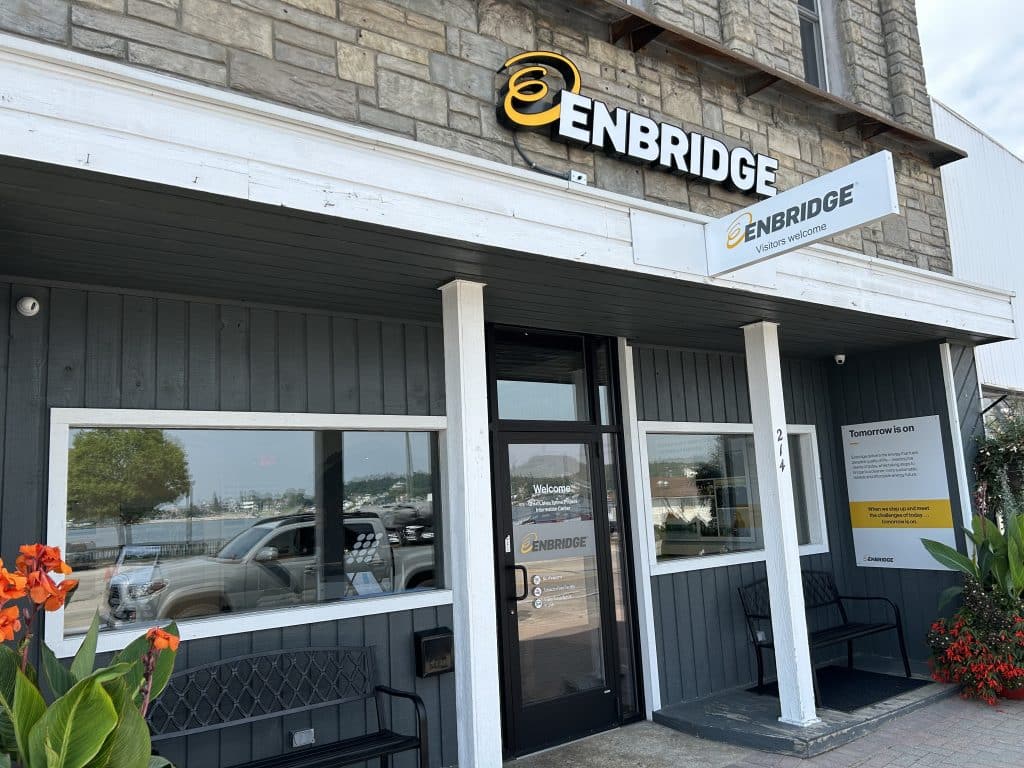
“Our Informational Center reflects Enbridge’s long-time commitment to this community, and also highlights in an engaging manner much of what makes the Straits unique and how Line 5 fits into that,” Meneghini says.
While construction is months away, the Great Lakes Tunnel Information Center remains open and Enbridge is active in a variety of community endeavors, including employees volunteering time with non-profits and first-response agencies, and donating grants and other monies to local non-profit organizations.
Once the tunnel project begins, it will take about five years to complete, including site preparation on both peninsulas. Construction of the tunnel itself will take about 18 months. At peak construction, about 200 workers will be employed.
The Great Lakes Tunnel Information Center is located 214 N. State St., St. Ignace. Hours are: 9:30 a.m. – 3:30 p.m. Tuesday, Thursday and Friday.
Related Articles

The outsized economic impact of Higher Education in the U.P.
The study demonstrates the profound impact Michigan’s public universities have on the state and all of its communities in economic activity, job creation and tax revenues generated.
Houghton named a Michigan five-star entrepreneurial hub
This five‑star recognition underscores Houghton’s commitment to building a vibrant, resilient, and opportunity‑rich community.
Pitch, Please. The Outdoor Innovation Pitch Competition seeks new entrepreneurs in recreation
The grand prize is $50,000 in services and investments.