MSU Extension’s ERAIL program equips responders for livestock accidents in the U.P. and across Michigan
ERAIL trains first responders, law enforcement, and agricultural professionals to handle the unique challenges of livestock accidents.
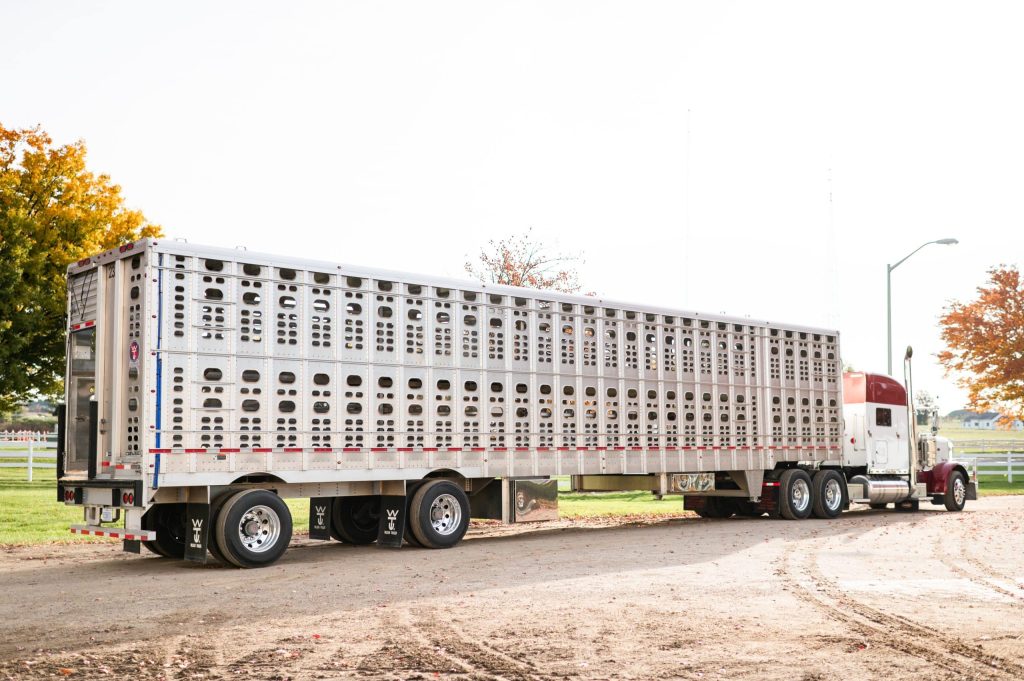
The morning was quiet until the screech of tires broke the silence. A cattle truck tipped sideways on a curve, steel grinding against pavement as the trailer door buckled open. Dozens of animals spilled onto the two-lane highway, some limping, some bolting toward the tree line. Drivers slammed on their brakes.
First responders arrived within minutes — but instead of smoke or flames, they were met with a tangle of hooves, horns, and panic.
It’s a nightmare scenario for firefighters and deputies trained to rescue people, not corral thousands of pounds of frightened livestock. And it’s exactly the kind of scene Michigan State University Extension’s Emergency Response to Accidents Involving Livestock (ERAIL) program is preparing them to face.
Developed to bridge a critical gap in emergency preparedness, ERAIL trains first responders, law enforcement, and agricultural professionals to handle the unique challenges of livestock accidents. Through classroom lessons, hands-on exercises, and specialized trailers stocked with equipment, the program equips participants to protect human safety, safeguard animal welfare, and prevent chaos from spiraling out of control.
Earlier this month, that training came north to the Upper Peninsula State Fairgrounds in Escanaba, where approximately 30 local responders gathered for a full day of instruction, simulation, and collaboration.
Special training
Semi-trailers packed with cattle, pigs, or horses — along with countless smaller trucks and trailers hauling animals for farms, fairs, and competitions — travel Michigan highways every day. Most arrive safely, but when an accident does occur, the consequences can be complex and unpredictable, presenting a crisis few responders have ever practiced for.
Responders quickly learn that rescuing animals in distress requires a different mindset than rescuing people. ERAIL instructors spend much of the day explaining how animal behavior under stress can turn a manageable crash into a dangerous one if not properly understood.
For Beth Ferry, an MSU Extension educator in Berrien County and a lead member of the ERAIL team, the program’s purpose is both practical and preventative.
“For first responders, they are skilled professionals but sometimes lack the animal handling and behavior skills to properly handle an accident scene when animals are involved,” she said. “That’s the beauty of the ERAIL program—we’re able to provide skill training for our first responders and ease the minds of the farmers with animals traveling the roadways in Michigan.”
More than 95 percent of ERAIL trainees report feeling more skilled and comfortable responding to livestock-related accidents after attending.
“For the ERAIL team, that’s a win in our book,” Ferry said.
While not strictly a disease-management course, biosecurity is woven throughout.
“Each of our team members are well-versed in disease prevention, response, and preparedness,” Ferry said. “All ERAIL trailers are equipped with disinfectant and PPE specifically to aid in disease prevention.”
Bringing ERAIL north
Until recently, ERAIL training was concentrated in Michigan’s southern counties, close to the state’s largest livestock operations. But as Ferry and her team expanded the program, the U.P. became a natural next step. Highways like U.S. 2 and M-28 are major east–west routes for livestock transport, and responders in rural counties often have fewer resources when the unexpected happens.
“People probably don’t realize it, but there’s a lot of animals running through the U.P. between the slaughterhouses and the auction barns,” said Forsyth Township Fire Department Captain Ron Lauren, who attended the Escanaba training. “Most of them are on the road between midnight and seven in the morning. A lot of people don’t even know they’re out there.”
Lauren’s department is the only one in the U.P. currently equipped with an ERAIL trailer — a mobile unit stocked with panels, pig boards, halters, and other tools designed to contain animals safely after an accident.
“It’s got cattle panels and pig boards so if the animals are in the trailer, you can get the good ones — the ambulatory ones — out and put them into a pen until another truck comes to pick them up,” he explained.
Lauren, who also owns a farm, said the training reinforced what his crew already knew but gave them the structure to train others.
“We’ll take what we learned and put together a plan for our department,” he said. “MSU has some virtual tutorials, and we’ll start doing that so we’re ready if something happens.”
He also offered a note of public caution: “The safest thing is don’t pull out in front of them, because they’re not stopping. Between the semi and the 50,000 pounds of weight they’re hauling, it’s almost 80,000 pounds total.”
Inside the training
ERAIL is not a lecture series — it’s a hands-on, practical exercise. Responders spend time in the classroom, but much of the learning happens outside, where instructors recreate accident scenes and guide participants through containment and rescue drills.
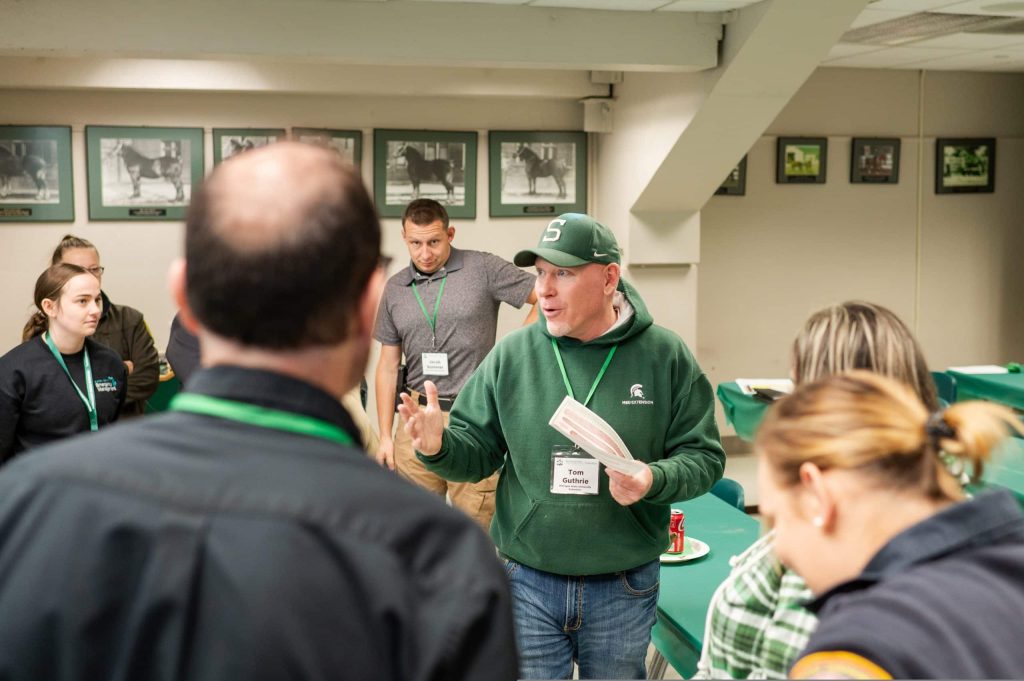
“Responding to an accident involving horses may vary dramatically compared to other livestock accidents,” said Tom Guthrie, MSU’s statewide equine extension educator.
“Animal behavior, in addition to the total investment that horse owners have in their animals, is complex and includes considerations like emotional attachment, monetary investment, and competitive goals. A horse can live for 25-plus years and may be owned by the same family for much of that time. Keeping these factors in mind may help minimize some of the chaos around the accident scene.”
Guthrie has seen the training make a measurable difference. “I’m aware of several occasions where ERAIL-trained first responders have utilized ERAIL equipment to catch and corral loose horses,” he said. “In another incident involving a trailer load of sows, responders quickly and efficiently devised a plan to safely and securely transfer the animals from the damaged transport trailer to other livestock trailers to be transported off scene.”
These scenarios illustrate what makes ERAIL distinct: It trains responders to think beyond their usual framework, incorporating animal behavior, human emotion, and interagency coordination into every decision.
Law enforcement and partnership
From a law enforcement standpoint, Spl/Lt. Benjamin Eckola of the Michigan State Police’s Eighth District said flexibility and communication are essential.
“Our primary priorities at any crash scene are ensuring people’s safety, providing aid if necessary, securing the scene, restoring traffic flow, and conducting an investigation,” Eckola said. “MSP collaborates with additional agencies and community resources as necessary in unique or uncommon situations, such as crashes involving non-wildlife animals.”
That kind of collaboration —between emergency responders, farmers, and agencies—is what ERAIL was built to encourage. “When we debrief an accident situation, those involved tell us that having the ERAIL response trailers makes a huge difference in the efficiency of the response and the overall safety of the scene,” Ferry said. “One of my favorite quotes from a responder was, ‘Man, that trailer saved our butts out there today.’”
The road ahead
ERAIL’s success has exceeded expectations. “If you would have told me five years ago that the demand for the ERAIL program would be what it is today, I would have called you crazy,” Ferry said. “We’ve even worked with a number of other states, helping and guiding them toward building ERAIL programs of their own.”
Looking ahead, the team hopes to integrate ERAIL into Michigan’s Career and Technical Education programs, introducing agriculture and law enforcement students to livestock safety early in their training.
“We’ll continue to advocate for funds for farmers and first responders so we can put tools and resources into the hands of the people that need them,” Ferry said.
When a livestock hauler tips over on a dark highway, chaos can unfold in seconds. ERAIL ensures that when it does, Michigan’s responders will know how to keep calm, act fast, and protect the lives —human and animal— that depend on them.
Related Articles
Partridge Creek Farm sets Giving Tuesday campaign to bolster food access
The farm hopes to raise $5,000 to upgrade free community grazing beds at the Ishpeming Middle School garden.
Donald W. Koivisto: An advocate for Upper Peninsula farms
He built a reputation for bipartisanship, cooperation, and steady attention to rural concerns.
Niche farms in the U.P. and rural Michigan receive grants to expand
Small family farms in rural Michigan receive state grants to expand operations.