
Building Stability: Black Rock Crossing’s 45-year commitment to affordable housing
Black Rock Crossing in Marquette, a partnership between Woda Cooper Companies and the Keweenaw Bay Indian Community, addresses regional housing shortages with 50 affordable units.
Editor’s note: This story is made possible thanks to support from Lake Superior Community Partnership.
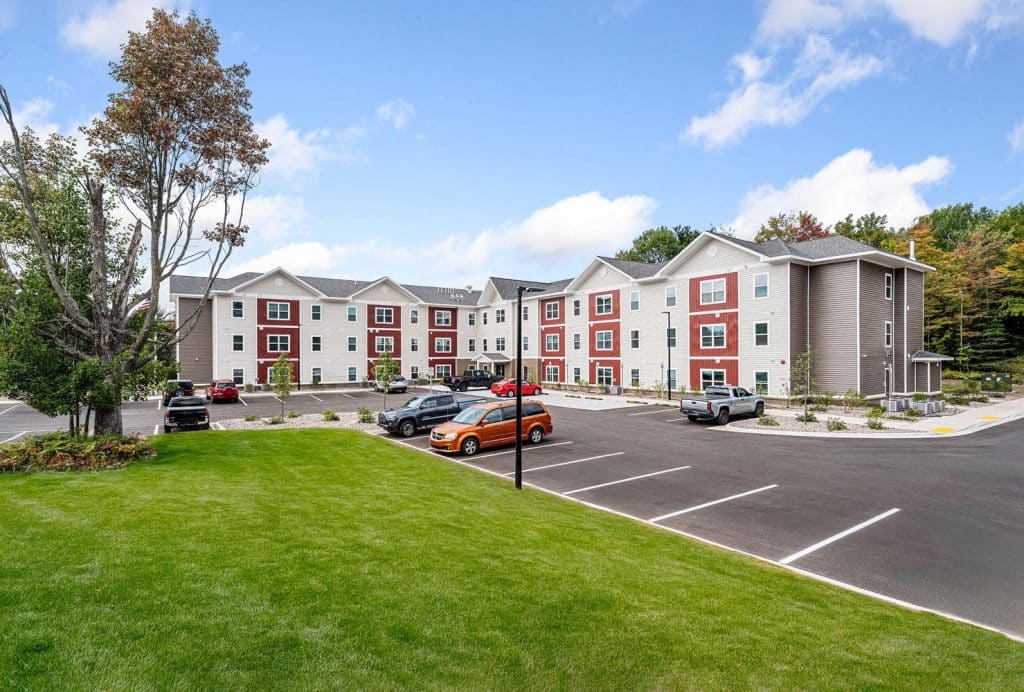
The November opening of Black Rock Crossing has injected 50 critical units into Marquette’s strained housing market, marking a milestone collaboration between Woda Cooper Companies and the Keweenaw Bay Indian Community (KBIC).
Located at 1506 W. Ridge St., the state-of-the-art complex targets low-income residents earning between 30 percent and 80 percent of the Area Median Income.
The complex features a strategic mix of 24 two-bedroom and 26 one-bedroom units, with nine apartments specifically set aside for enrolled tribal members.
To maintain long-term affordability, rents are scaled from $302 to $1,175 based on household size and income.
The development signals a deepening of regional ties, with tribal administrators working in lockstep with private developers and city officials from inception to completion.
KBIC CEO Brigitte LaPointe-Dunham framed the project as a direct response to a national housing crisis that has hit Marquette County particularly hard.
“We were a co-developer on the project,” LaPointe-Dunham stated, noting that the initiative leverages tribal trust land to serve the significant KBIC population residing within the city. “It strengthens regional partnerships and overall economic development… getting people to live within the city and providing a real option for our members.”
Beyond its economic impact, the project is a sustainability leader, achieving LEED Zero Energy certification—ensuring that residents benefit from high-efficiency living and reduced utility costs.
The nine units reserved for KBIC help address a critical shortage in the tribe’s own housing inventory. Many of the community’s larger homes are underused because they are occupied by just one or two individuals. The tribe intends to house those individuals at Black Rock Crossing and free up space families.
The remaining 41 units are expected to have a similar impact on families and young professionals who have been priced out of Marquette’s housing market.
Craig Patterson, who is senior vice president of development for Woda Cooper, low- and moderate-income developments like Black Rock Crossing can act as an indirect form of economic stimulus. The housing could attract teachers, medical technologists, daycare workers and entrepreneurs, he said.
He added that income-based rent and other factors help these residents “keep their families afloat or put more cash in their pocket to spend in the community.”
In addition to cost-savings, Black Rock Crossing offers amenities that sharpen the property’s appeal, including access to a fitness center, playground, and community room. Free snow removal, on-site maintenance, and lawn care, combined with energy-efficient HVAC and kitchen appliances, further reduce living expenses.
A majority of the project’s up-front funding came from the Low-Income Housing Tax Credits administered by the Michigan State Housing Development Authority.
Through a scoring system called the Qualified Allocation Plan, developers compete for the low-income housing tax credits based on a complex mix of criteria, including local population metrics, energy efficiency and tribal partnerships. The program favors projects in areas with the highest need for new low-income construction.
As a LEED Zero Energy-certified, tribally co-managed property, Black Rock Crossing was awarded $1,453,400 in credits through the state housing development authority’s 2023 funding round.
That was bolstered by project-based assistance for eight units through the Marquette Housing Commission, as well as a local Payment in Lieu of Taxes (PILOT) arrangement that supplemented the early injection of low-income housing tax credits funds with ongoing support to keep rents low in the long term.
To keep the project sustainable, Patterson explained that the property pays a service fee based on rental income rather than standard taxes. This trade-off is tied to a recorded deed covenant: for the next 45 years, Black Rock Crossing is legally committed to housing stability, keeping rents locked in at 30 percent to 80 percent of the Area Median Income.
That 45-year commitment, 15 years longer than the federal minimum for low-income housing projects, is an example of the high bar set from the project’s earliest stages through to the ribbon-cutting in early November.
“The quality of the housing for this development is huge,” said LaPointe-Dunham. “I felt like they put a lot of good work into it. They made it modern and energy efficient—things that people are looking for these days, but at a good price. It was nice to work within that.”
Related Articles

CDFIs help rural Michigan communities fund affordable housing, education, and support small business growth
Rural communities often experience a lack of capital access due to bank mergers, or community banks leaving their areas. CDFIs step in to bridge the gap by providing crucial capital, workshops, and referrals to rural communities — funding affordable housing, high-quality education, and community development with small business growth.
CEDAM’s new guide helps communities use tax incentives for housing
CEDAM has released a new housing TIF guide to help Michigan communities understand and apply tax increment financing as a tool to support local housing development and affordability goals.
Heritage Trails to break ground on ‘missing middle’ homes in Marquette Township
The project aims to deliver 48 attainable homes over the next two years, with the first phase of 24 single-family homes slated to begin construction this month.