Teaching the Future: How Marquette-Alger Schools are embracing AI integration
Students will gain an understanding of the foundations and workings of AI before learning to apply the technology responsibly and create AI-supported solutions.
Artificial intelligence (AI) is now a fact of life. It is everywhere.
Our lives rely on it and are impacted by it every day. Ask Google a question, and an AI answer will be your first response. You can’t navigate from here to there, use streaming services, pay your bills through a banking app or filter spam out of your email without using AI.
How is the next generation going to learn to use AI competently, intelligently, safely and ethically? How are they going to incorporate it into their lives and careers without letting it harm them?
In the Marquette and Alger County schools, they’re going to learn all that and more through a new course that is being added to the curriculum next fall. The Marquette-Alger Regional Educational Services Agency (RESA), which provides support services, professional development and technical assistance to local school districts, is adding an artificial intelligence course to its Career and Technical Education (CTE) program.
It’s the first such program in the U.P., according to Erich Ziegler, CTE director at the Marquette-Alger RESA. “How do machines actually learn, and when should we trust them? This course will help students find out,” he says.
The course will be held at the Seaborg Math & Science Center at Northern Michigan University. It is open to all high school students in the Marquette and Alger schools. Participants will receive state-certified CTE credits for taking it.
Students will gain an understanding of the foundations and workings of AI before learning to apply the technology responsibly and create AI-supported solutions, Ziegler explains. The course will examine human-centered values, including fairness, safety, privacy and responsibility. It will explore AI’s role in the creative arts, government and human rights; its environmental impact, and its ramifications for careers.
“Project-based learning will emphasize critical thinking, ethical decision-making and practical skills with data and AI tools, preparing students for college, careers and informed participation in a technology-rich society,” Ziegler says.
He considers the new course a vital addition to the Marquette-Alger curriculum. “We can’t not incorporate/teach/educate our students about AI, because it is the future,” he says. “Understanding how to use it, the ethics behind it, how it works, how to apply it—that is key.”
Ziegler says it is ultimately an equity issue. “If we ignore it, it will lead to a ‘Matthew Effect’ for our students and communities.” The Matthew Effect means that the rich get richer, and the poor get poorer, he explains. “If we ignore AI, those with resources will figure out how to use it to their benefit, and those without resources will not. In education, our role is to help all.”
AI in Ypsilanti Schools
The Ypsilanti Community Schools have become an AI in education pioneer as the sole Michigan school district and one of just 11 nationwide chosen for a competitive AI training initiative, the nine-month AIxCoherence Academy program run by Education First, a national organization dedicated to improving education. This initiative provides comprehensive coaching and workshops for staff, ensuring that the integration of AI aligns with intended educational outcomes.
Ypsilanti Community High School has been designated the inaugural HP AI Spotlight School. As a result, the high school has received cutting-edge technology and resources, fostering an environment rich in AI-focused learning. The school is actively weaving AI into diverse aspects of its curriculum, aiming to significantly enhance student learning and career readiness.
The high school is also expanding its CTE offerings to incorporate AI education. The goal is to equip students with vital skills such as problem-solving, data literacy and automation knowledge, preparing them for the demands of the modern workforce. The district is also exploring innovative uses of AI and virtual reality to deliver hands-on learning experiences in fields like automotive repair, engineering and nursing. The school system believes that these immersive opportunities have the potential to lead directly to trade certifications and employment.
Beyond the AI curriculum, the Ypsilanti Public Schools are promoting digital literacy, providing computers to all students from first to twelfth grade, developing technological proficiency and providing equitable access to online learning.
West Ottawa Schools
The West Ottawa Public Schools in Holland, Michigan, are also actively integrating AI literacy into their curriculum. They’re doing so to prepare students for future employment in the Holland area, where large employers are increasingly demanding AI competency.
West Ottawa High School introduced a course called AI Foundations for College & Careers in the 2025-2026 school year. It focuses on teaching students how to use AI responsibly and ethically, covering concepts like crafting precise prompts, evaluating outputs and the importance of keeping a human in the loop. The curriculum also emphasizes critical thinking, especially regarding AI’s limitations and the potential for misinformation.
Students receive both math and English credits for completing the course.
National Efforts
Nationally, the Association for the Advancement of Artificial Intelligence (AAAI) and the Computer Science Teachers Association (CSTA)are co-sponsoring an initiative called AI4K12. The AAAI says it is an international nonprofit society that fosters scientific research into the mechanisms of intelligent behavior and their machine embodiment.
The initiative is developing national guidelines for AI education for K-12, an online, curated resource directory to facilitate AI instruction, and a community of practitioners, researchers, and resource and tool developers focused on AI for K-12 students.
“Society is in the midst of a fourth industrial revolution powered by artificial intelligence and robotics” says Carnegie Mellon
University Professor David Touretzky, co-chair of AI4K12. “K-12 students need to understand these technologies because their future careers will be shaped by them. Every educated adult should know a bit about how AI works, just as they should know how electricity works, or how molecules work.”
In the Gwinnett County Public Schools northeast of Atlanta, Georgia, a new high school’s computer science program is teaching students how to build AI tools to tackle real-world problems.
Seckinger High, a 2,000-student school, offers students an advanced, three-course AI pathway that Lisa Watkins, executive director of instructional technology and innovation for the Gwinnett County Public Schools, says provides “rigorous technical learning” for students interested in careers developing AI tools.
The courses include an introduction to the foundations of AI, which delves into the basics of computer programming, data science and mathematical reasoning, followed by two more courses building on these foundations and teaching students to design and apply AI solutions to real-world problems using machine learning and professional software development tools.
“AI is changing the job market, it’s changing how we work and it’s changing the skills students will need,” says Watkins. She points to a recent World Economic Forum report noting that employers are already seeking workers with AI skills, reorienting their business models around AI, planning to phase out roles that can be automated and firing employees who don’t have specific AI skills or a desire to learn them.
And in Massachusetts, the Massachusetts STEM Advisory Council and the Massachusetts Technology Collaborative are partnering with an initiative called Project Lead The Way to develop and pilot components of an AI-related curriculum in school districts across the state.
The pilot program is expected to support 45 educators in 30 school districts, giving 1,600 students across Massachusetts hands-on opportunities to explore the technologies shaping the future of work and life.
“This partnership is about more than piloting a new course—it’s about preparing students to think critically about the role of artificial intelligence in their lives and in our democracy,” said Massachusetts Education Secretary Patrick Tutwiler. “By coupling educator training with a cutting-edge curriculum, we are equipping students with both the technical skills and the ethical grounding to use AI responsibly and creatively in college, careers and civic life.”
Dyane Smokorowski, coordinator of digital literacy at the Wichita (Kansas) Public Schools, sums it up this way: “AI isn’t something you can block anymore—it’s reality.”
For Marquette and Alger county students, it’s about to become reality founded in understanding and knowledge.
Related Articles
Transformational $30M state investment to build the future of tech and science at LSSU
Lake Superior State University has secured a historic $30 million state appropriation to fund 75% of a major $40 million renovation and expansion of its Center for Applied Science and Engineering Technology.
The Sound of Survival: Inside the U.P. company quieting the military’s loudest hardware
A Calumet-based defense contractor specializing in acoustic engineering and sound-canceling hardware for the U.S. military, has completed an $8.5 million facility expansion.
How Michigan farmers are using a new app to make critical crop decisions right from the tractor
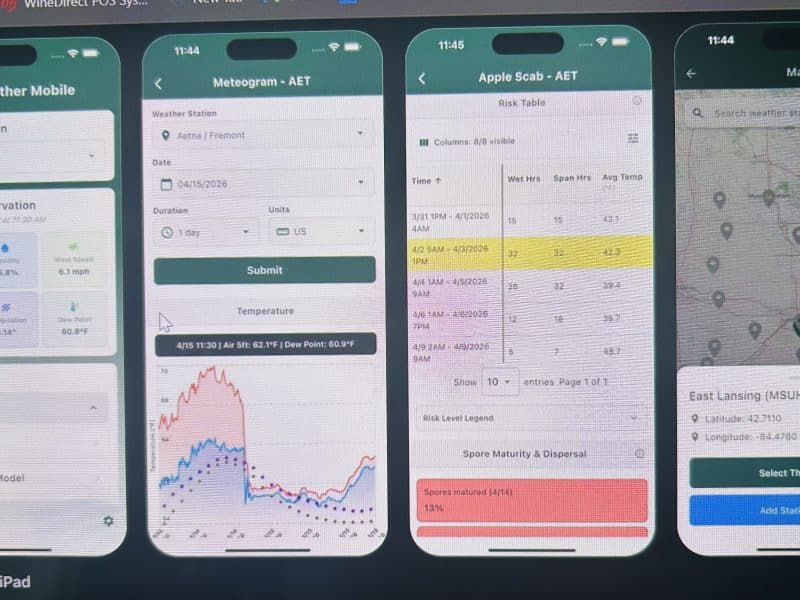
The free Enviroweather Mobile app, developed by Michigan State University specialists and the Michigan State Horticultural Society, provides farmers with real-time environmental data and predictive crop modeling on their smartphones.