
More Than a Base: The unfading shadow of K.I. Sawyer
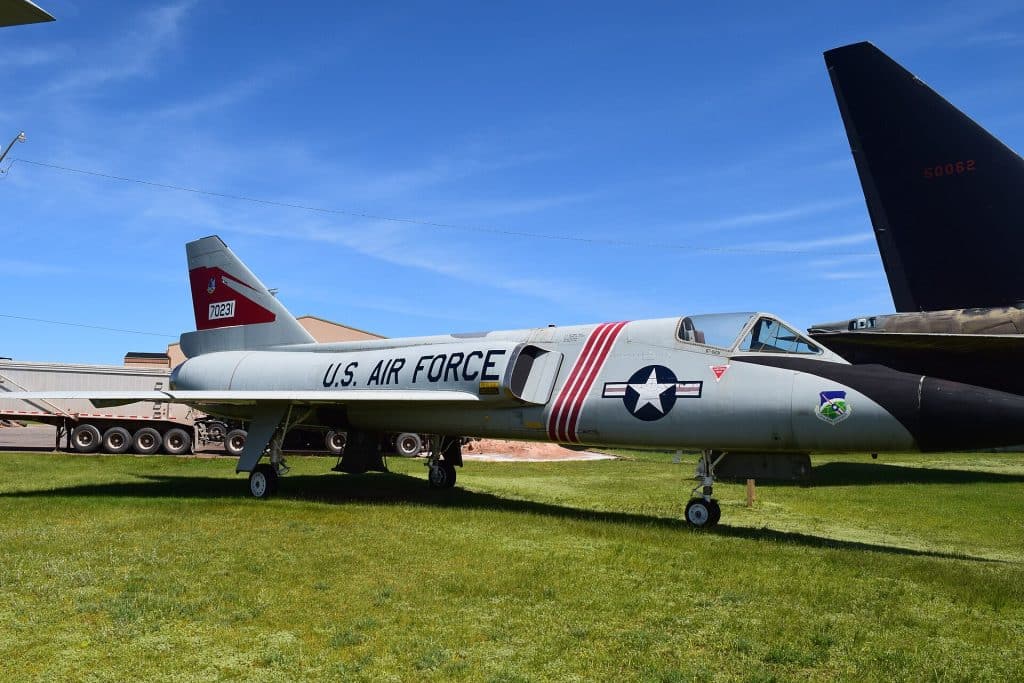
At over 5,200 acres, the base’s massive size made redevelopment a challenge. However, several buildings have since been successfully repurposed, and a portion of the site now thrives as the Marquette Sawyer Regional Airport.
Bundled in a winter coat despite the May calendar, 9-year-old Jessica Tessi pointed her mittened hand toward a string of headlights inching through the dark U.P. night.
“I’ll bet that’s them right now,” she said to her father, Colin, as a 20-car motorcade crept down County Road 553.
It was near 11:30 p.m. on May 12, 1993, and more than a thousand vehicles lined both shoulders of the road near the entrance gate of K.I. Sawyer Air Force Base, according to a report in The Mining Journal published the following day.
Families wrapped in blankets waved flashlights and honked horns as Defense Base Realignment and Closure (BRAC) Commissioner Robert D. Stuart Jr. passed through. Spectators came from across the region—Delta, Dickinson, Marquette counties and beyond—to send a unified message: Don’t close the base.
For those who lived and served at K.I. Sawyer, the memory of that night still holds. The B-52s are gone, the commissary is shuttered and the control tower, once left quiet, now handles regional flights through Marquette Sawyer Regional Airport.
Some stayed to preserve what they could, while others carried the place with them through deployments and retirements. Together, they describe a base that shaped lives, defined communities and, in the eyes of many, was lost too soon.
Before the Bombers
Before K.I. Sawyer became a Cold War stronghold, it was a stretch of forest near Gwinn and an idea held by a county road commissioner.
In the 1930s, Kenneth Ingalls Sawyer believed Marquette County needed an airport to drive growth, particularly as the mining industry expanded. A smaller airport opened in 1937 between Marquette and Negaunee, but by 1941, plans were already shifting toward something larger. A new facility was mapped out on 5,200 wooded acres in Forsyth Township—land that would eventually host nuclear bombers and radar towers.
During World War II, the site was considered as a possible U.S. Army Air Corps base, but the military ultimately selected Kinross, near Sault Ste. Marie. Even so, construction continued. After the war, the airport was completed and named in honor of Sawyer, who did not live to see it finished.
In 1949, Nationwide Airlines became the first commercial carrier to operate flights from the newly named K.I. Sawyer Airport. Within a few years, however, the site was reshaped entirely. By 1955, the U.S. Air Force had leased the airport from the county to develop a joint-use base, and in 1956, K.I. Sawyer Air Force Base officially opened.
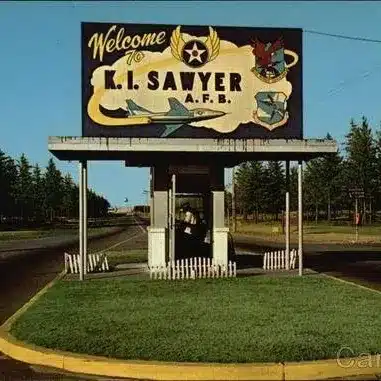
Over the following decades, the base became a central piece of the nation’s northern defense strategy. The 473rd Fighter Group was stationed there initially, later becoming the 56th Fighter Group and host to the Sault Ste. Marie Air Defense Sector. By 1963, the mission had shifted to nuclear deterrence, and the 410th Bombardment Wing brought with it a fleet of B-52H Stratofortresses and KC-135 Stratotankers.
K.I. Sawyer remained a Strategic Air Command installation through the end of the Cold War, transitioning to Air Combat Command in 1992. By then, its future was already being measured less by mission capability and more by cost.
“It Was a Gem”
Retired Chief Master Sergeant Ken Charfauros arrived at K.I. Sawyer in the early 1990s after being forced to leave Blytheville Air Force Base in Arkansas due to its closure. The uncertainty weighed heavily on his family, especially his wife Pam, who had been hesitant about the new assignment. Originally from Guam, Charfauros was no stranger to relocation, but Michigan’s winters were a stark contrast to island life.
Still, the move proved transformative. “I had to beg Pam for forgiveness,” he said, laughing at the memory. “Two weeks there, and I said, ‘I love this place.’” The U.P.’s snow was no match for the sense of community they found.
“You get a sense of pride in where you’re at,” he said. “The camaraderie, the support, the mission. It was all there. It was a gem of a base.”
Charfauros served through the base’s drawdown and closure. Two of his three children were born at K.I. Sawyer. He spent months sealing buildings, consolidating equipment and saying goodbye to friends and squadrons. The disruption—his second experience with a base closure—left a lasting mark. “I still think of Sawyer as my best base, my most enjoyable base. I would have stayed if they let me,” he said.
What stayed with him most was the people. “We were more one family than anything—on the base and off the base,” he said. “Once you opened your arms to the community, they opened theirs right back. I never felt uncomfortable anywhere in the U.P.”
As BRAC moved forward, that sense of stability unraveled. Airmen received transfer orders, some chose early retirement, and others uprooted children who had just settled into local schools. Charfauros and a colleague spent months consolidating tools, sealing hangars and watching squadrons depart, and the silence that followed, he said, was devastating.
The Pentagon’s Math
Despite the show of support on County Road 553, the Department of Defense had already reached its conclusion. According to the 1993 BRAC Commission Report to the President, closing K.I. Sawyer would save $167.3 million by 1999, with a one-time closure cost of $143.6 million. Annual savings would eventually reach $62.4 million.
The Base Realignment and Closure process, created under the Defense Base Closure and Realignment Act of 1990, aimed to reduce excess military infrastructure following the Cold War. The Pentagon determined the Air Force had more large aircraft bases than it needed. Unlike Grand Forks or Minot, K.I. Sawyer lacked a ballistic missile field, limiting its strategic flexibility under the START II treaty.
Though its location offered open airspace and strong deployment potential, Sawyer ranked low in overall military value. Its B-52Hs were reassigned to Barksdale Air Force Base in Louisiana, and its identity as a bomber-only installation became a liability as the military shifted toward multifunctional bases.
Local leaders argued Sawyer’s location made it an ideal forward-deployment base, positioned between the coasts. They also questioned the broader impact of losing yet another Michigan installation following the closures of Kincheloe and Wurtsmith.
The Human Cost
None of that translated cleanly to the families living in base housing or the civilian employees whose jobs disappeared.
“We were spending $16 million a month in the local community,” said retired maintenance chief Richard Verwey, who arrived at Sawyer in 1981 and remained long after the Air Force left. “We had 4,000 active duty, 1,200 civil service, and about 7,000 dependents.”
At its peak, K.I. Sawyer was the largest single employer in the Upper Peninsula.
Verwey described a culture defined by precision and pride, recalling one winter when a B-52 slid off the runway. “We had one that played snowmobile two winters in a row,” he said, chuckling. “That was KI.”
He also remembered Congressman Bart Stupak touring the base shortly after taking office. Stupak opposed the closure, but the outcome had already been set.
“The closure affected everything,” Verwey said. “The morale. The jobs. The heartbeat of the region. We were the economy.”
Today, Verwey helps run the K.I. Sawyer Heritage Air Museum, housed in a former alert building. “All I could do was preserve the piece I was responsible for,” he said. “But you walk through the old industrial area now, and it breaks your heart.”
Rebuilding from Rubble
Following the closure in 1995, redevelopment proved uneven. The base’s size—more than 5,200 acres—made reuse difficult, and while some buildings sat empty for decades before being repurposed, others deteriorated beyond repair. A number have been reused: a school, a church, a housing authority, small businesses and a steadily operating airport now known as Marquette Sawyer Regional Airport. Many others were eventually demolished.
Environmental contamination has remained a persistent obstacle. K.I. Sawyer is still listed as an active Superfund site, and the Air Force has spent millions addressing soil and groundwater contamination from fuels, solvents and firefighting foams. PFAS compounds, now linked to long-term health risks, remain among the concerns.
Even so, signs of reinvestment have begun to take shape.
Marquette County will mark one of its most visible projects on June 13, with the reopening of Little Trout Lake Park following a nearly $1 million renovation tied to the Silver Lead Creek Greenway. The park has been reshaped into a central trailhead and gathering space, with new amenities including a lakefront pavilion, pickleball and volleyball courts, accessible pathways and areas designed for events and small markets. Funded in part through a Michigan Department of Natural Resources SPARK grant, the project reflects a shift toward long-term community use of former base infrastructure—an effort to restore function in a place long defined by what was lost.
Still, the scars remain.
What Was Lost
The economic vacuum left behind was as severe as predicted. Projections warned of unemployment rates climbing as high as 24 percent across the region. Businesses closed. Families left. Gwinn and surrounding communities lost not just income, but a sense of identity.
Some stayed and began the slow work of rebuilding. Charfauros, who retired in 2010 and now runs a business in South Dakota, still returns when he can, walking through old neighborhoods and measuring memory against what remains. “What you remember and what it actually is today is saddening,” he said. “But I love this place. I always will.”
So do the thousands who lined the road that night in 1993—flashlights raised, engines idling, hoping to slow something that was already in motion.
Decades later, their message still lingers—carried not just in memory, but in what remains, and in what is still being rebuilt.
Related Articles

CDFIs help rural Michigan communities fund affordable housing, education, and support small business growth
Rural communities often experience a lack of capital access due to bank mergers, or community banks leaving their areas. CDFIs step in to bridge the gap by providing crucial capital, workshops, and referrals to rural communities — funding affordable housing, high-quality education, and community development with small business growth.
CDFIs help rural Michigan communities fund affordable housing, education, and support small business growth
Rural communities often experience a lack of capital access due to bank mergers, or community banks leaving their areas. CDFIs step in to bridge the gap by providing crucial capital, workshops, and referrals to rural communities — funding affordable housing, high-quality education, and community development with small business growth.
More Than a Base: The unfading shadow of the U.P.’s K.I. Sawyer
At over 5,200 acres, the base’s massive size made redevelopment a challenge. However, several buildings have since been successfully repurposed, and a portion of the site now thrives as the Marquette Sawyer Regional Airport.