
How Michigan farmers are using a new app to make critical crop decisions right from the tractor
The free Enviroweather Mobile app, developed by Michigan State University specialists and the Michigan State Horticultural Society, provides farmers with real-time environmental data and predictive crop modeling on their smartphones.
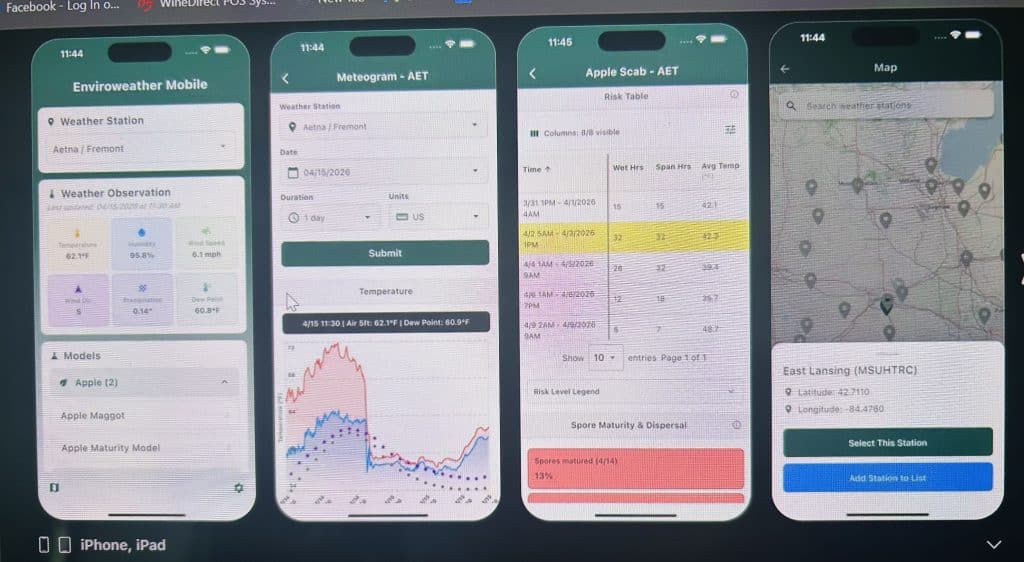
Imagine you’re a Michigan fruit grower, standing out in the orchard miles away from your office desktop. You planned to spray today, but looking up at the trees, you’re uneasy—are the wind conditions actually as favorable as the morning forecast predicted? How can you know for sure, right now, without heading back to the house?
Thanks to a new mobile app developed by Michigan State University agricultural specialists, growers can now access real-time environmental and weather data on the go. This instant access helps inform critical, time-sensitive decisions and enables precise farming techniques—even miles away from the office.
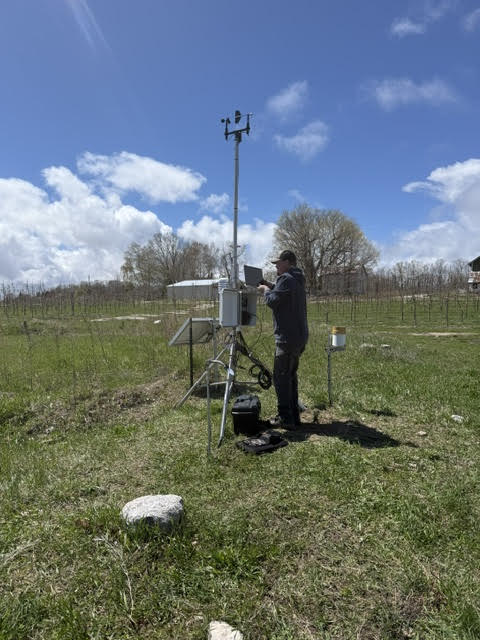
The free Enviroweather Mobile app is a joint project of MSU AgBioResearch and the Michigan State Horticultural Society (MSHS). The app provides growers with on-the-go access to the Enviroweather data system, an agricultural information program powered by 119 automated stations strategically placed across Michigan. These stations continuously monitor critical field conditions, including air and soil temperature, rainfall, wind speed, relative humidity, leaf wetness, and multi-depth soil moisture.
Enviroweather has helped Michigan producers make informed decisions related to pest control, plant production and natural resource management since 1996. Up until now, however, data gathered by the tool could only be accessed reliably from a desktop using a web browser.
Solar powered, automated and programmed to collect data every five minutes, the stations are able to transmit that data via cellular connection at 5-, 15-, 30-, 60-, or 180-minute intervals, depending on station and season.
Southwest Michigan farmer Ben Smith notes that the app is especially valuable for specialty crop growers, who must constantly monitor environmental conditions to safely and effectively apply pesticides.
As executive director of the MSHS, Smith brings plenty of hands-on experience to the table; he has spent 12 years managing his family’s grape vineyards, corn, and soybean acreage in Watervliet and Benton Harbor.

“Enviroweather (desktop) has always been a very robust and capable tool, but it’s really designed for sitting at a computer laptop and (seeing) a big screen,” Smith explains. “Some displays just aren’t possible to see on a phone. Now, growers can use a phone effectively to get the same info while out in the field or on a tractor.”
While Smith regularly checks the system’s weather data, he finds its predictive modeling capabilities even more valuable. Plugging in key data, for example, enables the system to predict how his crops will be affected by predominant weather conditions, diseases and/or insects in his geographic area.
“It can take a starting date, measure insect growth and say when the insects will be susceptible to insecticide,” he says. “It tells me I need to apply (insecticides) on those dates.”
According to a 2024 report by global asset finance company DLL, data-gathering tools like Enviroweather are driving the future of agricultural strategy. Ultimately, these technologies are crucial to meeting a projected 70 percent increase in global food demand by 2050.
Data from the United States Department of Agriculture underscores this shifting landscape: in 2025, 36 percent of Michigan’s 44,000 farms and ranches utilized precision agriculture practices. The agency defines this high-tech approach broadly, encompassing everything from GPS guidance and yield mapping to variable-rate input applications, drone scouting, electronic tagging, and robotic milking.
Unsurprisingly, smartphones are central to this digital evolution. The same USDA data reveals that 82 percent of all farms nationwide were using smartphones in 2025.
Teamwork: Student work helps fuel app development
Keith Mason, MSU’s Enviroweather coordinator, explains the Enviroweather system was initiated in 1996 as area specialty crop growers increasingly sought comprehensive data to inform their field management. The desktop version worked effectively but around 2016 farmers began asking for more convenient access to that info as they worked in the fields.
That launched efforts to reconfigure the website for improved mobile friendliness via both smartphone and android. By 2023, Enviroweather leaders had enlisted MSU seniors to tackle the problem as part of their coursework through the Computer Science Capstone Experience.
A grant from the Michigan Dept. of Agriculture helped with development, as did knowledge from the University of Florida and Cornell University about their own digital weather tools. Credited for final app development are MSU graduate student Dao Chi Lam and the MSU AgBioResearch Research Evaluation and Data Analytics teams.
Other funding came via the Rural Development’s Specialty Crop Block Grant Program; from the Michigan Dept. of Agriculture; and from Project GREEEN, the plant ag collaborative made up of MSU AgBioResearch, MSU Extension and the Michigan Plant Coalition
These days, Enviroweather is run by an 8- to 10-person staff of IT professionals and field technicians who monitor and manage both the data collection and the equipment.
Half its funding comes from the National Mesonet Program which uses Enviroweather data in its aggregate of high-quality weather data from multiple U.S. locales. But Mason says the future of that funding is in question right now.
In the U.P., Ryan Pelletier is tapping the Enviroweather app to monitor weather conditions on potato seed fields in McMillan and Newberry. The farms were founded by the Walther family in the 1940s; the fourth-generation family operation grows potatoes in Michigan and elsewhere for the potato chip and fresh produce markets.
“We were using the desktop version before, but I just really like the convenience of looking information up on my phone,” says Pelletier, who has been with the company for about six years. “It’s in a simpler format and takes less time.
Pelletier and his crew use the app frequently when they’re planting to monitor weather and other conditions. “Since we plant around the clock, this gives me the ability to see whether we should keep planting or should stop,” he says.
“It’s still pretty new, but the app already has some new models based on our crops, and I’m excited to see how those work out this summer.”
Enviroweather mobile can be downloaded for free on the Apple App Store or Google Play.
Related Articles
State issues Line 5 permits despite conceding its ‘significant impacts’
Michigan state agencies have issued key environmental permits for Enbridge Energy’s controversial Line 5 tunnel project, ruling that its energy safety benefits outweigh its severe impacts on Native American burial grounds and local ecosystems, though the project still faces looming federal approvals and ongoing legal battles.
State issues Line 5 permits despite conceding its ‘significant impacts’
Michigan state agencies have issued key environmental permits for Enbridge Energy’s controversial Line 5 tunnel project, ruling that its energy safety benefits outweigh its severe impacts on Native American burial grounds and local ecosystems, though the project still faces looming federal approvals and ongoing legal battles.
Transformational $30M state investment to build the future of tech and science at LSSU
Lake Superior State University has secured a historic $30 million state appropriation to fund 75% of a major $40 million renovation and expansion of its Center for Applied Science and Engineering Technology.