
From Campus Project to Market Success: How one NMU student reimagined camping
How does a college project turn into a thriving outdoor brand? Discover how NMU student Evan BeVier and healthcare founder Gretchen Heinen scaled their big ideas with the help of Innovate Marquette SmartZone.
Growing up in Traverse City, Evan BeVier loved nothing more than heading into the woods and going camping.
When he enrolled at Northern Michigan University (NMU) in Marquette, surrounded by some of the most scenic and accessible wilderness in the state, that passion intensified.
“With so many scenic and accessible camping areas, I had to take advantage of it,” he explains.
But there was one constant frustration that always threatened to ruin the experience: the tedious, time-consuming chore of pitching a tent.
“Camping prep is a lot,” BeVier explains. “You’ve already got to pack all your gear, haul it out to your favorite spot, then spend even more time wrestling with your tent, trying to set it up. I figured there must be a better way.”
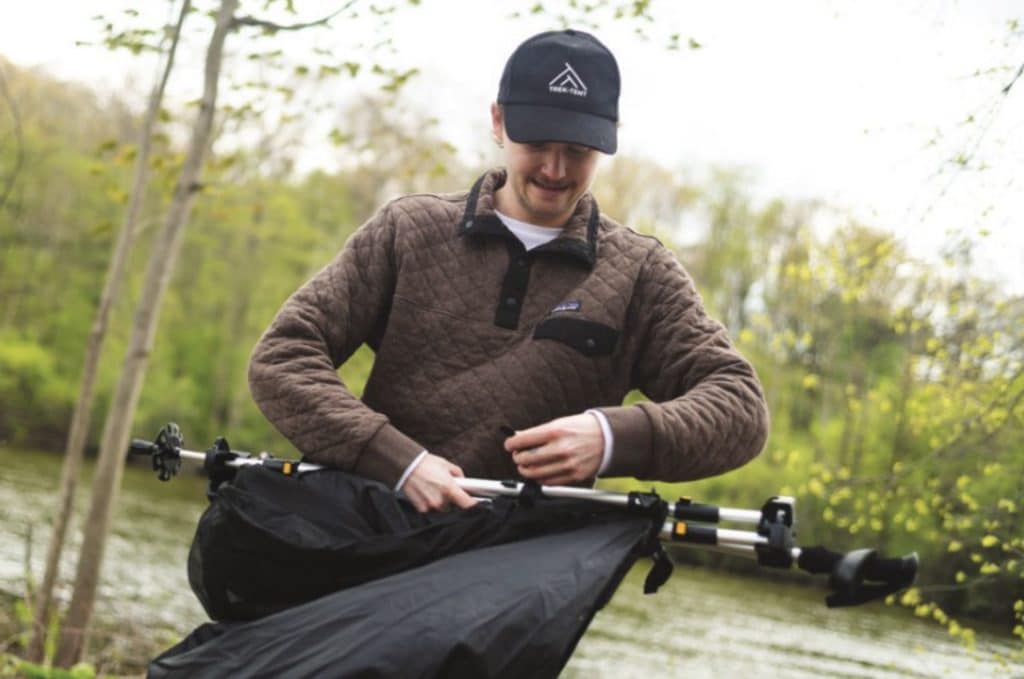
Driven by that lifelong passion for the outdoors, BeVier used his mechanical engineering technology senior project to solve the problem. Inspired by the simple mechanics of an umbrella, he designed an intuitive frame that sets up in just 60 seconds. When condensed, the frame doubles as a rugged hiking staff.
“By taking some basic mechanics from an umbrella, I was able to design an intuitive frame that sets up in 60 seconds, giving campers more time to enjoy the outdoors,” he recalls. Then he realized that the condensed frame resembled a hiking staff. “So I added a handle grip at one end to allow the user to use it as a hiking staff in rough terrain.”
That single classroom brainstorm ultimately helped the NMU student turn his senior project into a thriving outdoor recreation company called TerraHike Outdoors. To scale his invention—the TrekTent—from a prototype into a market-ready product, BeVier turned to Innovate Marquette SmartZone, an idea incubator and product development program right on NMU’s campus.
“If others can do it, I can do it,” he thought.
Innovate Marquette provided help the student entrepreneur didn’t even know he needed: refining his idea, determining his market, finding funding, and building his brand.
The result was the TrekTent and BeVier’s company that sells it, TerraHike Outdoors. BeVier launched a Kickstarter campaign in early 2025. The response was enormous, and TerraHike quickly surpassed its funding goal. To produce the first round of tents, TerraHike partnered with Tentsile—a British outdoor gear company—to fulfill the initial Kickstarter orders. Today, the TrekTent is available for purchase directly through TerraHike’s website.
But Innovate Marquette’s support didn’t end when the product hit the market.
“Owning a business is a nonstop learning experience,” says BeVier. “You are constantly making new decisions and adapting. Innovate Marquette offers advice, expo and pitch opportunities, connections and more. Who knows the challenges I will face next year, but I do know that Innovate Marquette will be there to guide me through them.”
Innovate Marquette SmartZone
Innovate Marquette is one of 21 SmartZones established by the Michigan Economic Development Corporation (MEDC) to fund high-tech startups. Founded in 2018, it offers resources such as funding, mentoring, business skills training, and market research to innovators, entrepreneurs, and business owners in the Marquette area. By leveraging local and statewide networks, it brings capital, workforce talent, and a collaborative mindset to the Upper Peninsula and beyond.
It is unique because it is the only SmartZone that supports both product development entrepreneurs and high-tech startups, says Innovate Marquette CEO Joe Thiel. Innovate Marquette can do that because of a unique partnership with Invent@NMU, which focuses specifically on product development.
Thiel brings a broad range of technical, marketing, and business development experience to his leadership role. He studied industrial engineering at NMU and has worked as an engineer, supervisor, sales executive, management executive, entrepreneur, consultant, trainer, public speaker, coach, and mentor.

Much of the product development supported by Innovate Marquette is inherently outdoor recreation-related. “NMU students are out in the green spaces that surround Marquette,” Thiel explains. “They come up with cool ideas that can make their outdoor adventures easier, and those tend to be ideas that you can commercialize.” BeVier’s TrekTent is a prime example.
Outdoor recreation also attracts high-tech entrepreneurs, making high tech and outdoor recreation product development a symbiotic driver of regional economic growth. The vast array of outdoor recreation opportunities in the Marquette area regularly draws high-tech developers from across the country. “We have an entrepreneur who is relocating from Oregon and another who recently relocated here from San Francisco,” says Thiel.
Several of Innovate Marquette’s startups have also been able to attract critical venture funding from outside Marquette and even outside Michigan, further boosting the local economy. Three of them have successfully drawn funding from Florida, Thiel notes.
Funding depends heavily on market potential, he adds. “Some of our startups have been able to draw funding from outside of Michigan, from a lot of different sources, because their market potentials are so huge and they’re in industry sectors that are obviously valuable,” Thiel explains.
Expanding Horizons: Authsnap
One of those high-potential companies is Authsnap, founded by Gretchen Heinen. As a utilization management nurse, Heinen had seen—and long been frustrated by—how manual insurance appeals consumed precious clinical time, delayed reimbursement, and sometimes interrupted patient care.
She had an idea that she wanted to transform into a business capable of easing the path through the insurance appeals maze. She combined AI-powered software with clinical expertise to help hospitals and healthcare providers recover lost revenue while reducing the administrative burden placed on care teams. The Authsnap platform streamlines the appeals process by identifying the exact clinical evidence needed to challenge denied claims, helping providers spend less time on paperwork and more time focused on patient care.

“Innovate Marquette understood both the business opportunity and the potential patient impact,” she says. “They provided hands-on business coaching, investor introductions, commercialization support and connections to organizations such as the Michigan State University (MSU) Research Foundation and MSU College of Human Medicine. They also provided direct funding for consultants and patent-related assistance, along with a lot of hours of direct support from experienced founders and investors.”
Heinen says the biggest challenge facing her fledgling company was securing their first customer and proving that a startup could solve a complex problem in the highly regulated healthcare environment. “At the same time, we had to build the right combination of clinical, technological, and business expertise without compromising clinical accuracy, data security, or patient impact,” she says.
Heinen’s vision has taken wing. Authsnap was officially named the number one rural tech company last year by the national Center on Rural Innovation.
A Culture of Growth
Innovate Marquette takes a unique approach to success: they teach their clients to face failure head-on. “We have a systematic model,” says Thiel. “We call it ‘Scale fast, fail faster and safe. Survive fastest and thrive.’ We allow our founders to fail, to pivot rapidly, scale very quickly and get to the point where they can make a decision on whether to stick with their idea or change.”
However, many unique challenges face startup entrepreneurs in the Upper Peninsula. One that rarely comes to mind is the historical cultural attitude of the surrounding community.
Mining and forestry have long been the mainstay industries in the U.P., and the region is accustomed to traditional businesses that produce a physical product like iron ore or logs. Consequently, it can sometimes be difficult for locals to wrap their minds around the underlying value of high-tech startups, Thiel points out.
“High tech is very difficult to convey because it’s not traditional,” he says. “It’s very erratic. The funding is difficult because you’re venture capital funding, and you’re funding on projections and you’re funding on potential. And the success rate is maybe two in 10. So you have to have an appetite for risk. The challenge is for the local community to understand the huge potential: what these startups can bring when they become successful.”
Related Articles
Stormy Kromer expands 2026 collegiate lineup to 38 universities across 12 states
Stormy Kromer has launched its expanded 2026 Collegiate Collection, growing to 38 universities across 12 states. Every piece in the collection is cut and sewn in Ironwood.

Beautifying the World One Skein at a Time: The microscopic magic of UP North Yarns
Monica Thoune, a 72-year-old former teacher, combines her background in science education and economic development to run UP North Yarns, a successful hand-dyed yarn business in the Upper Peninsula
A tale of three cities: How small businesses foster U.P. local economies
Rich histories and tight-knit, hard-working communities drive the U.P.’s economic development.