Unmanned drones are scouring Lake Superior for vital fishery data.
“Sustainable fisheries management is imperative not only for the long-term health of the fisheries but for the Great Lakes ecosystem as a whole,” says Matt Womble, Saildrone director of ocean data programs.
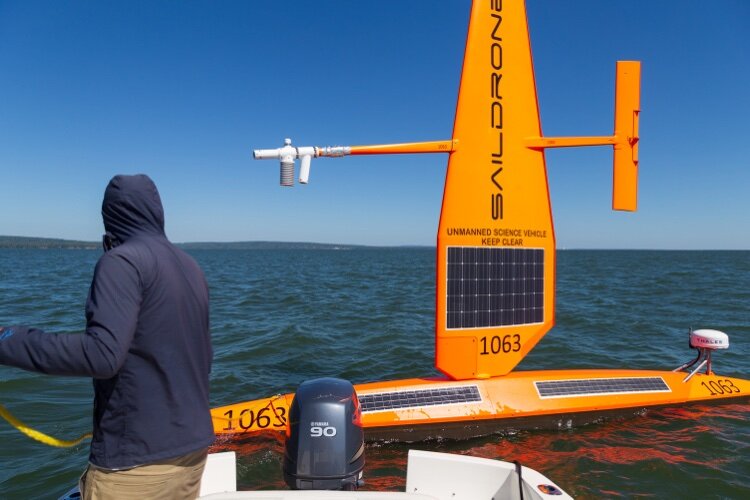
What’s happening: Sailors and fishing boats out on the waters of Lake Superior shouldn’t be alarmed if they come across an unmanned, bright orange 23-foot vessel cruising atop the lake. That’s because it’s likely one of two uncrewed surface vehicles (USVs) launched by California-based Saildrone, Inc. as part of a 25-day mission to collect critical data on the health of this most vital ecosystem.
The mission: Launched on Wednesday, Aug. 10, the two Saildrone Explorers are equipped with sensors that collect fish distribution and density data throughout Lake Superior. Scientists from the U.S. Geological Survey (USGS) will use the data to better understand how large vessel engine noise affects fish sampling and catchability. The saildrones themselves are touted as being virtually silent and have zero operational carbon footprint. USGS scientists will also analyze Lake Superior’s rainbow smelt population, which is considered an invasive prey fish species that is already well-established in the Great Lakes ecosystem.
Why it’s important: The Great Lakes fishing industry — including commercial, recreational, and tribal fisheries — is valued at producing more than $7 billion per year and supports 75,000 jobs throughout the region. The Lake Superior mission is part of a larger multi-year mission in the Great Lakes led by the USGS with state, federal, tribal, Canadian provincial, private, and non-profit partners. This is the second year that Saildrone Explorers have collected data in the Great Lakes; Saildrone Explorers traveled from Holland, Mich., to Port Huron in 2021.
What they’re saying: “The USGS strives to continuously enhance the quality of our science by integrating cutting-edge technologies into our research,” says Peter Esselman, a USGS biologist and the project lead. “The data collected during this Lake Superior mission will help Great Lakes fishery managers make the most informed decisions possible to sustain the fishery.”
Got a development news story to share? Email MJ Galbraith here or send him a tweet @mikegalbraith.
Related Articles
Six U.P. organizations awarded America250MI History grants
The America250MI program is a state-level initiative that provides funding to help local historical organizations develop projects as part of the country’s 250th anniversary celebration.

Bay Mills Community College plans state-of-the-art health care facility
The new facility will feature a state-of-the-art nursing simulation lab and an EMT lab, providing hands-on, real-world training for aspiring healthcare professionals.

Michigan Iron Industry Museum closed due to roof damage
The structural damage was caused by heavy snow; the roof is intact but several trustees that bear the roof’s weight began cracking on Feb. 21.