
The Sound of Survival: Inside the U.P. company quieting the military’s loudest hardware
A Calumet-based defense contractor specializing in acoustic engineering and sound-canceling hardware for the U.S. military, has completed an $8.5 million facility expansion.
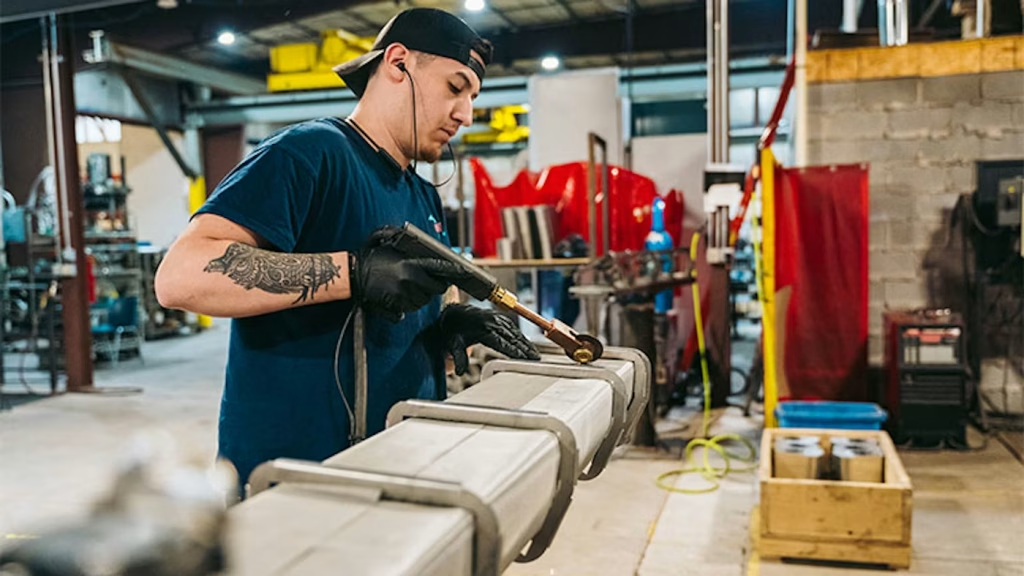
Why does it matter if a tank, Navy ship, or fighter jet makes too much noise?
To the military, it’s a matter of survival.
“Practically, soldiers and sailors need to be able to communicate in and around these platforms,” says Steve Mattson, CEO of Great Lakes Sound & Vibration (GLSV). “Tactically, our platforms need to outshoot their audible detection range.”
Put simply: If your weapon has a range of half a mile, but the enemy can hear you coming from a mile away, you lose the element of surprise—and likely, the mission.
To keep pace with increasing defense demands, GLSV recently completed an $8.5 million expansion that doubled the footprint of its Houghton County airpark facility.
Funded in part by a $400,000 grant from the Michigan Strategic Fund’s Michigan Business Development Program—administered by the Michigan Economic Development Corporation (MEDC)—the expansion consolidates manufacturing operations under one roof. More importantly, it clears the runway for GLSV to secure larger defense contracts and add 42 skilled jobs to the region.

Solving that exact high-stakes problem is why GLSV was established in 1996. Based in Calumet, the company specializes in providing critical sound-canceling hardware and acoustic engineering solutions for the U.S. Army, Navy, and Air Force.
“We are incredibly grateful for the support of the Michigan Strategic Fund and the Michigan Economic Development Corporation, whose investment helped make this expansion a reality,” Mattson said at a ribbon-cutting ceremony at the new facility in March.
The Keweenaw Economic Development Alliance (KEDA) sees the company’s expansion as a major boost for the regional economy.
“Great Lakes Sound & Vibration is a unique business providing unique solutions to difficult problems at the Department of Defense,” said Jeff Ratcliffe, executive director of KEDA. “They continue their growth by adapting to the ever-changing defense industry needs for new and innovative solutions to sound and vibration, as well as new product development.”
To support this momentum, Michigan Works!, the state’s primary workforce development association, has proposed a $461,000 plan to help meet GLSV’s rising talent and training needs.
Heavy Duty Engineering
Today, GLSV works alongside nearly all the major defense contractors building modern military platforms. Their partner portfolio includes heavyweights familiar to the U.P., including Oshkosh Defense, Fincantieri Marinette Marine, General Dynamics, BAE Systems, and Bath Iron Works.
The projects GLSV tackles would stump standard manufacturers. The company’s engineering scope ranges from designing exhaust systems and custom duct assemblies to providing research and development services for aerospace giants—including Rolls-Royce M250 helicopter engines and the legendary B-52 Stratofortress.
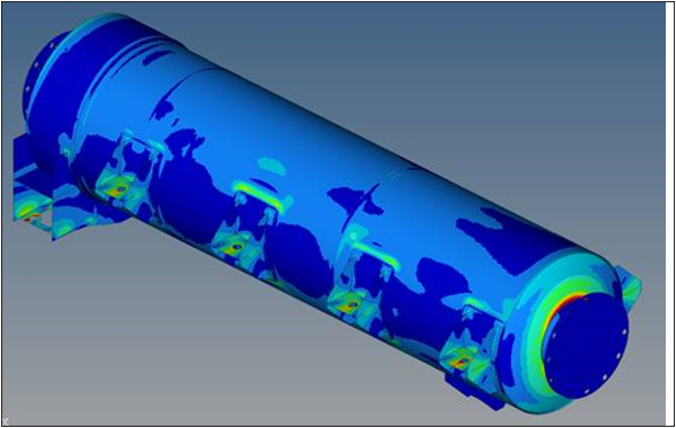
On the ground, GLSV produced the engine exhaust systems and cooling air outlet seals for General Dynamics Land Systems’ M10 Booker combat vehicle. GLSV executed the complete design, analysis, prototype building, and qualification testing to help the vehicle meet demanding acoustic and airflow performance goals.
“We have the agility to balance competing requirements and meet aggressive performance targets with high-performing solutions,” Mattson says.
Another high-profile Army contract led GLSV to develop a fully engineered, custom exhaust system for the Stryker A1 armored fighting vehicle. Tasked with maximizing acoustic performance within a highly restricted, tight space, GLSV engineered a system that successfully withstands extreme combat environments, including intense shock, vibration, and thermal shifts.
Because the upgraded Stryker A1 features superior engine power and mobility compared to older models, GLSV’s specialized exhaust system was designed to fit an entire family of seven vehicles operating on a common platform—ranging from anti-tank guided missile carriers and command vehicles to medical evacuation units. The Army subsequently tapped GLSV to optimize, prototype, and test a noise-attenuated cooling outlet duct for the Stryker A1 upgrade. GLSV is currently manufacturing both systems.
Other notable projects include:
- The Joint Light Tactical Vehicle (JLTV): GLSV secured a production supply contract for a newly developed quiet muffler for Oshkosh Defense, taking the project from initial concept to an active production line in just eight months.
- Marine Operations: For shipbuilders, GLSV provides comprehensive acoustic engineering alongside intake, exhaust, and silencer products. The team handled the design and analysis of a launch handling and recovery crane, a stern door and ramp for the Littoral Combat Ship (LCS), and designed ship service diesel generator exhaust silencers for the new Multi-Mission Surface Combatant (MMSC) vessel.
- Aerospace Innovation: GLSV supports powertrain integration for hybrid and mechanical aircraft, acoustic signature management, custom shocks and dampers, and exhaust systems for unmanned aerial vehicles (UAVs).
The more challenging the problem, the more the GLSV team enjoys tackling it. “We choose to work in difficult markets and take on the tough challenges,” says Mattson.
And what is the company’s most important project? “I guess I’d say the next one,” he says with a smile.
A Rural Defense Boom
GLSV’s success is part of a larger trend: Michigan is rapidly cementing its status as a defense industry powerhouse, with a growing footprint in rural areas like the U.P. According to Industrial Equipment News, defense spending in the state reached $1.5 billion in fiscal year 2023.

Spearheaded by the MEDC’s Office of Defense and Aerospace Innovation (ODAI)—launched in April 2024 to accelerate sector growth—the defense industry now contributes $30 billion in total economic activity across Michigan. Nearly 4,000 Michigan businesses serve the defense, aerospace, and homeland security sectors, collectively supporting more than 166,000 jobs.
In Calumet, GLSV isn’t the only player driving this rural tech boom. Neighboring Loukus Technologies is also making waves by specializing in advanced materials development and casting technologies for the defense and energy sectors.
Loukus has secured multiple defense contracts for research and development in advanced material systems, specifically supporting ground vehicles and mortar components. Working alongside industry partners, Loukus frequently collaborates with the U.S. Army Combat Capabilities Development Command Ground Vehicle Systems Center (GVSC).
To support its own $1.6 million expansion—which is slated to create 48 jobs—Loukus recently received a $300,000 performance-based grant from the Michigan Strategic Fund.
In announcing the state investments for both GLSV and Loukus Technologies, Lt. Governor Garlin Gilchrist II praised the Keweenaw Peninsula’s manufacturing momentum.
“They’re walking the walk when it comes to ‘Making it in Michigan,’” Gilchrist said. “I applaud their major contributions to the defense and energy sectors and can’t wait to see what they do next to help our communities thrive.”
Related Articles
State issues Line 5 permits despite conceding its ‘significant impacts’
Michigan state agencies have issued key environmental permits for Enbridge Energy’s controversial Line 5 tunnel project, ruling that its energy safety benefits outweigh its severe impacts on Native American burial grounds and local ecosystems, though the project still faces looming federal approvals and ongoing legal battles.
State issues Line 5 permits despite conceding its ‘significant impacts’
Michigan state agencies have issued key environmental permits for Enbridge Energy’s controversial Line 5 tunnel project, ruling that its energy safety benefits outweigh its severe impacts on Native American burial grounds and local ecosystems, though the project still faces looming federal approvals and ongoing legal battles.
Transformational $30M state investment to build the future of tech and science at LSSU
Lake Superior State University has secured a historic $30 million state appropriation to fund 75% of a major $40 million renovation and expansion of its Center for Applied Science and Engineering Technology.